Search visibility is no longer confined to a single list of blue links. Today, customers encounter businesses through map packs, AI-generated answers, local packs, voice responses, and location-based discovery experiences that look different depending on where and how a search happens.
As these search surfaces expand, traditional rank checking has become less reliable as a standalone metric. SERP tracking still matters, but its role has shifted. It is no longer the final scorecard for performance. Instead, it functions as one diagnostic signal inside a broader visibility framework.
What a SERP Tracker Actually Measures Today
At its core, a SERP tracker measures how a listing appears for a given query. But modern SERP tracking goes beyond a single numeric position.
It accounts for:
- Placement within the current search layout (above or below the fold)
- Presence inside SERP features such as local packs or AI summaries
- Practical visibility, including whether a result is immediately actionable
Two businesses may both rank on page one, yet only one is actually seen. In practice, visibility, not position, is what drives calls, clicks, and visits.
Why Rankings Alone No Longer Explain Performance
Rankings still provide directional insight, but they rarely explain outcomes on their own. Search results now shift based on proximity, filters, personalization, and AI-driven elements that change what users see before they ever scroll.
This is why traffic or lead volume can decline even when rankings appear stable. The listing may still exist, but its visual prominence has changed. Without tracking actual search layouts, those losses often go unnoticed until performance drops become difficult to recover.
Search Everywhere Optimization Changes How Visibility Is Measured
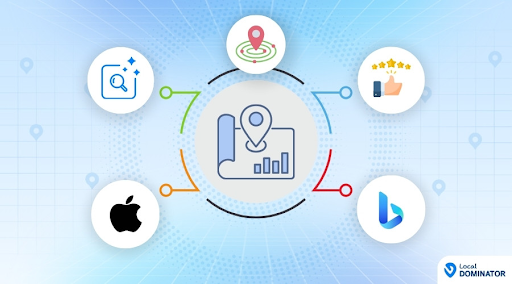
Search no longer happens in one place. Customers move fluidly between traditional search engines, map results, navigation apps, voice assistants, and AI tools.
Search Everywhere Optimization reflects this reality. The objective is not to win a single results page, but to remain discoverable wherever decisions are made. Measurement must follow the same logic. Visibility must be observed across environments, not isolated to a single SERP view.
This is where SERP tracking becomes most useful, not as a ranking trophy, but as a way to detect when and where visibility shifts occur.
Where SERP Tracking Fits Inside a Broader Visibility Workflow
On its own, SERP data answers only one question: How does a result appear in this moment? The more valuable insight comes from combining that signal with other visibility indicators.
For example:
- SERP tracking reveals that a business is consistently pushed below AI summaries or local features.
- Hyperlocal ranking data explains where that visibility loss is happening across neighborhoods.
- Local Pack and Maps separation clarifies whether proximity or prominence is the limiting factor.
Viewed together, these signals explain not just what changed, but why it changed.
A Practical Visibility Scenario
Consider a multi-location service business that maintains steady keyword rankings but experiences declining inbound calls.
SERP tracking shows that for high-intent queries, AI summaries and expanded local features now dominate the top of the page. Geo-based rank views reveal that while the business performs well near its physical address, visibility drops sharply across surrounding neighborhoods. Local Pack tracking further shows that competitors with stronger review profiles are winning prominence, even when proximity is similar.
In this scenario, SERP tracking identifies the visibility loss, hyperlocal data pinpoints its location, and local feature separation explains the competitive dynamic. The issue is no longer “ranking,” but discoverability across real search layouts.
Tools That Support Unified Visibility Measurement
Some platforms are designed to support this kind of multi-surface analysis by bringing SERP tracking, hyperlocal visibility, and local feature differentiation into a single workflow.
Local Dominator is one example of a Search Everywhere platform built around this concept. Local Dominator is a cloud-based Search Everywhere Platform specializing in unified local SEO and AI search tracking for local agencies and businesses. It serves as a single source of truth that integrates SERP analytics and citations to make visibility simple, predictable, and scalable across all digital touchpoints.
When used as part of a broader strategy, it helps teams interpret SERP data alongside location-based visibility, local pack performance, and citation consistency, allowing visibility issues to be diagnosed rather than guessed.
The value comes not from individual features, but from how multiple signals are interpreted together.
Looking Ahead at Search Visibility
Search will continue to evolve quietly. AI interfaces, dynamic layouts, and location-aware results are reshaping how customers discover businesses without obvious algorithm updates.
In this environment, understanding visibility means tracking what users actually see, not just where a listing technically ranks. SERP tracking remains an essential input, but its real strength emerges when it supports a wider, Search Everywhere view of discovery.
For modern teams, the goal is no longer ranking alone. It is sustained visibility wherever customers are looking.
