The discovery of interstellar comet 3i atlas marks another extraordinary milestone in modern astronomy. As only the third confirmed interstellar object ever detected passing through our solar system, this comet provides a unique and invaluable opportunity to study material formed around another star. Unlike ordinary comets bound to the Sun’s gravity, 3I/ATLAS originated far beyond our planetary neighborhood, traveling for millions or even billions of years through interstellar space before briefly crossing our cosmic doorstep.
In this comprehensive article, we explore what makes interstellar comet 3I/ATLAS special, how it was detected, what scientists can learn from it, and why this discovery reshapes our understanding of planetary systems beyond our own. Each section is structured to provide depth, clarity, and authoritative insight into one of the most exciting astronomical findings of recent times.
What Is Interstellar Comet 3I/ATLAS?
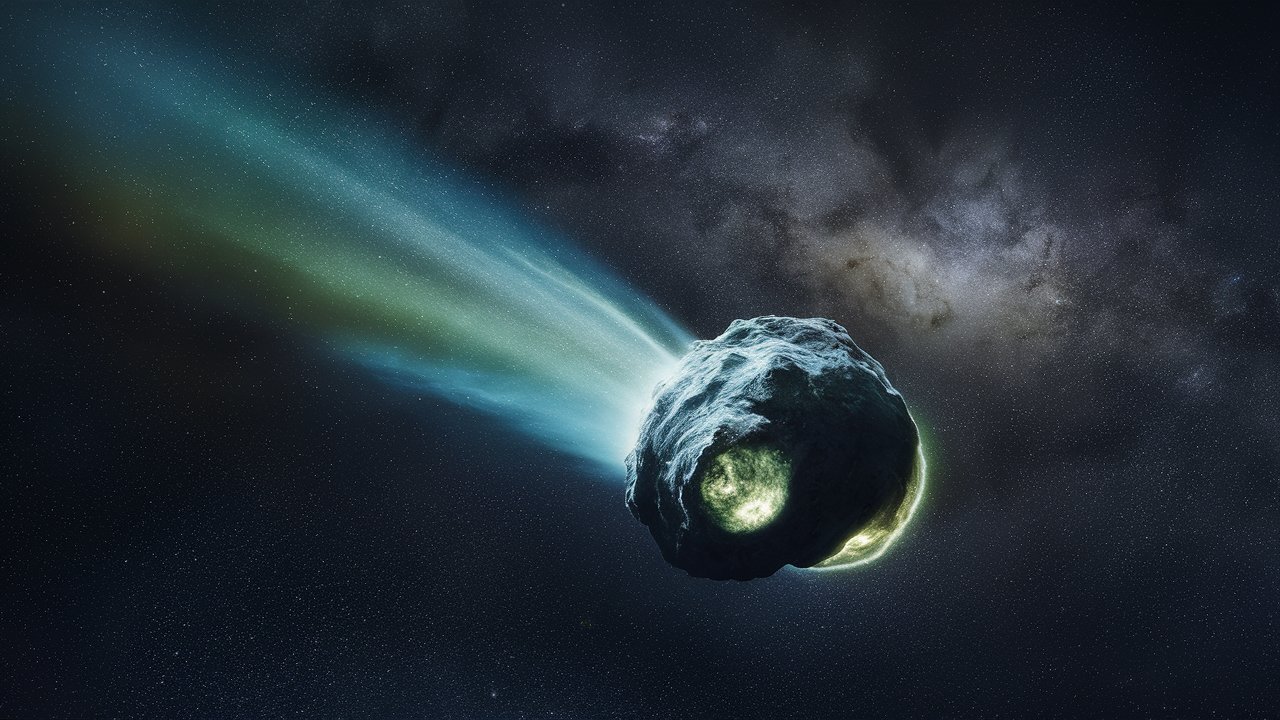
What distinguishes 3I/ATLAS from earlier interstellar objects is its clear cometary activity, including a visible coma and tail formed as solar radiation heats its icy surface. This makes it fundamentally different from the first known interstellar object, ʻOumuamua, which showed no obvious outgassing, and closely related to 2I/Borisov, which was also a true comet. Together, these objects form a new class of celestial visitors that provide direct samples of exoplanetary material.
Discovery of 3I/ATLAS and the Role of Modern Sky Surveys
The detection of 3I/ATLAS was made possible by the ATLAS (Asteroid Terrestrial-impact Last Alert System) survey, a network of wide-field telescopes designed to scan the entire sky repeatedly. This system uses automated detection algorithms to identify objects with unusual motion, brightness, and orbital characteristics.
Once flagged, follow-up observations from ground-based and space telescopes confirmed its non-solar origin, based on its velocity and orbital eccentricity. The ability to detect such faint and fast-moving objects is a testament to how far astronomical technology has advanced, opening the door to routine detection of interstellar visitors in the future.
Orbital Path and Velocity: Proof of an Interstellar Origin
One of the most compelling features of interstellar comet 3i atlas is its extreme velocity relative to the Sun. Moving significantly faster than solar system comets, its inbound speed could not be explained by gravitational interactions with known planets. Its hyperbolic orbit clearly indicates that it came from outside the Sun’s gravitational influence.
This orbital path suggests that 3I/ATLAS was likely ejected from its parent star system during the early stages of planetary formation, possibly through gravitational interactions with giant planets. Such ejections are thought to be common in young planetary systems, meaning interstellar space may be filled with countless objects like 3I/ATLAS.
Composition and Physical Characteristics of 3I/ATLAS
Spectroscopic analysis of interstellar comet 3I/ATLAS reveals a composition rich in volatile ices, dust, and organic compounds. As the comet approached the Sun, solar heating caused these materials to sublimate, forming a coma that could be studied in detail by astronomers.
The chemical fingerprint of this comet offers direct evidence of planetary chemistry beyond our solar system. Early data suggests similarities to solar system comets, but also notable differences in molecular ratios, indicating that other star systems may form planets and minor bodies under different chemical conditions.
Why Interstellar Comet 3I/ATLAS Matters to Science
The scientific importance of 3I/ATLAS cannot be overstated. For the first time, researchers can analyze a comet that formed around another star without sending a spacecraft across light-years of space. This turns a rare cosmic event into a natural interstellar sample-return mission.
By studying its composition, structure, and behavior, scientists can test theories about planetary system formation, the distribution of organic molecules in the galaxy, and even the potential origins of life. Each interstellar object detected strengthens the statistical foundation needed to understand how common such bodies are in the Milky Way.
Implications for Planetary Formation Beyond the Solar System
The existence of interstellar comet 3i atlas supports the idea that planetary systems frequently eject material during their evolution. This process populates interstellar space with billions of comets, asteroids, and fragments of protoplanetary disks.
These findings suggest that planet formation is a dynamic and chaotic process, not a gentle and isolated one. The study of interstellar comets allows astronomers to compare the building blocks of planets across different star systems, helping answer fundamental questions about whether our solar system is typical or unusual.
How Astronomers Observe and Study 3I/ATLAS
Observations of 3I/ATLAS involve a combination of optical telescopes, infrared sensors, and spectroscopic instruments. Timing is critical, as the comet will only be visible for a limited period while passing through the inner solar system.
Astronomers focus on measuring:
-
The rate of outgassing
-
The structure of the coma and tail
-
Changes in brightness over time
-
Chemical signatures of released gases
These observations are coordinated globally to ensure that no detail is missed during its brief visit.
The Future of Interstellar Object Discovery
The discovery of interstellar comet 3I/ATLAS signals the beginning of a new era in astronomy. With next-generation observatories such as the Vera C. Rubin Observatory, scientists expect to detect dozens of interstellar objects each year, transforming these once-rare events into routine observations.
As detection rates increase, astronomers will be able to categorize interstellar bodies by type, composition, and origin, providing an unprecedented map of material exchange between star systems. 3I/ATLAS stands as a pioneer of this emerging field.
Conclusion: A Cosmic Messenger With Lasting Impact
As technology improves and discoveries accelerate, objects like 3I/ATLAS will continue to reshape our understanding of planetary science, cosmic evolution, and humanity’s place in the universe.
Frequently Asked Questions (FAQ)
What does 3I/ATLAS mean?
The designation 3I/ATLAS identifies it as the third known interstellar object (“3I”) discovered, with ATLAS being the survey that detected it.
Is 3I/ATLAS dangerous to Earth?
No. The comet follows a safe trajectory and poses no threat to Earth or other planets.
How long will 3I/ATLAS be visible?
Visibility depends on its brightness and distance from the Sun, but such objects are typically observable for a few months at most.
Why are interstellar comets so rare?
They are not truly rare, but difficult to detect due to their high speed, faintness, and unpredictable trajectories.
Will we be able to visit one with a spacecraft?
Future missions are being designed to intercept interstellar objects, and discoveries like 3I/ATLAS help refine those plans.